Enter gem5
Simulation is cool, but what’s the deal with gem5?
By the end of this section, you will be able to:
- Describe the purpose and goals of the gem5 simulator.
- Explain how gem5 differs from cycle-accurate RTL simulators.
- Describe the roles of gem5’s C++ backend and Python frontend.
- Identify the predecessor simulators to gem5.
What’s gem5?
gem5 (yes, always in lowercase) is a computer architecture and microarchitecture simulator comprised of two other simulators: M5 (created at Michigan by students of Steve Reinhardt, principally Nate Binkert) and GEMS (created at Wisconsin by students of Mark Hill and David Wood). It combines the simulation framework of M5 with the detailed memory system of GEMS.
What kind of simulator is gem5?
In the context of the simulation types we covered in the previous section, gem5 is an execution-driven, full-system simulator. It is also a cycle-level simulator: let’s talk about what that means.
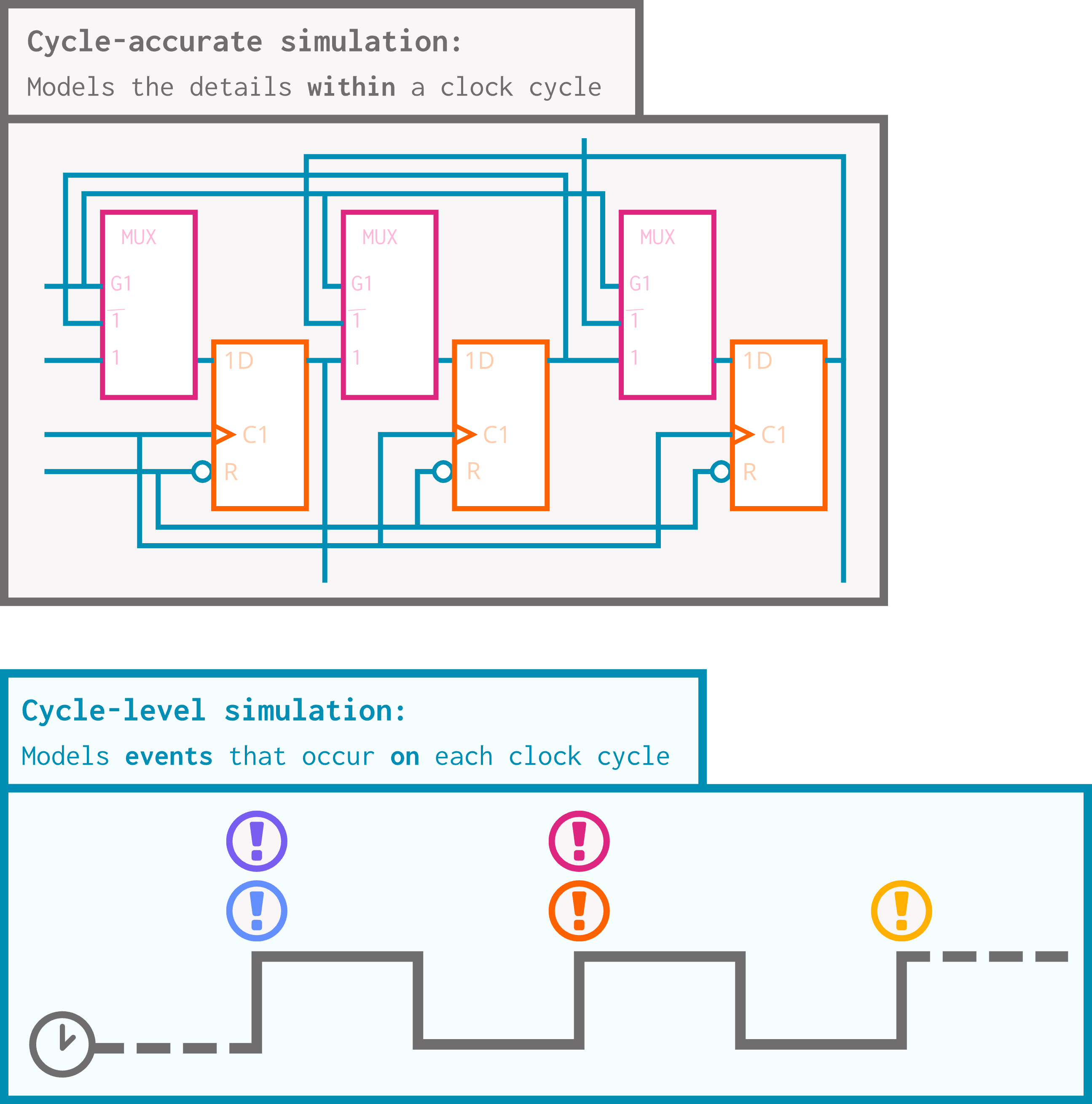
You may be familiar with Register Transfer Level (RTL) code written in Hardware Description Languages (HDLs) like Verilog (if not, that’s ok!). In RTL, the programmer specifies, and the simulation simulates, every wire and register present in the system. This makes RTL very similar to the actual hardware being simulated. We call this kind of simulation cycle-accurate. Cycle-accurate simulation is very high-fidelity, but it’s much harder to configure, and it’s more difficult to combine functional and timing information.
Cycle-level simulators like gem5, on the other hand, do not simulate every wire and register in the system and don’t concern themselves with what happens within a clock cycle. Cycle-level simulation only models which events occur cycle-by-cycle. This means that a gem5 simulation won’t match up perfectly with hardware, but it’ll have similar timing, which is often what we care about. Cycle-level simulation is also faster than cycle-accurate simulation: this is because cycle-level simulators can “cheat” and emulate some things instead of fully simulating them.
How is gem5 organized?
Programmers interact with gem5 using C++ and Python. The backend of gem5, including all of its simulation models (hundreds of them), is written in C++, while Python provides the front-end interface. C++ provides the models, and Python sets parameter values and controls the simulation.
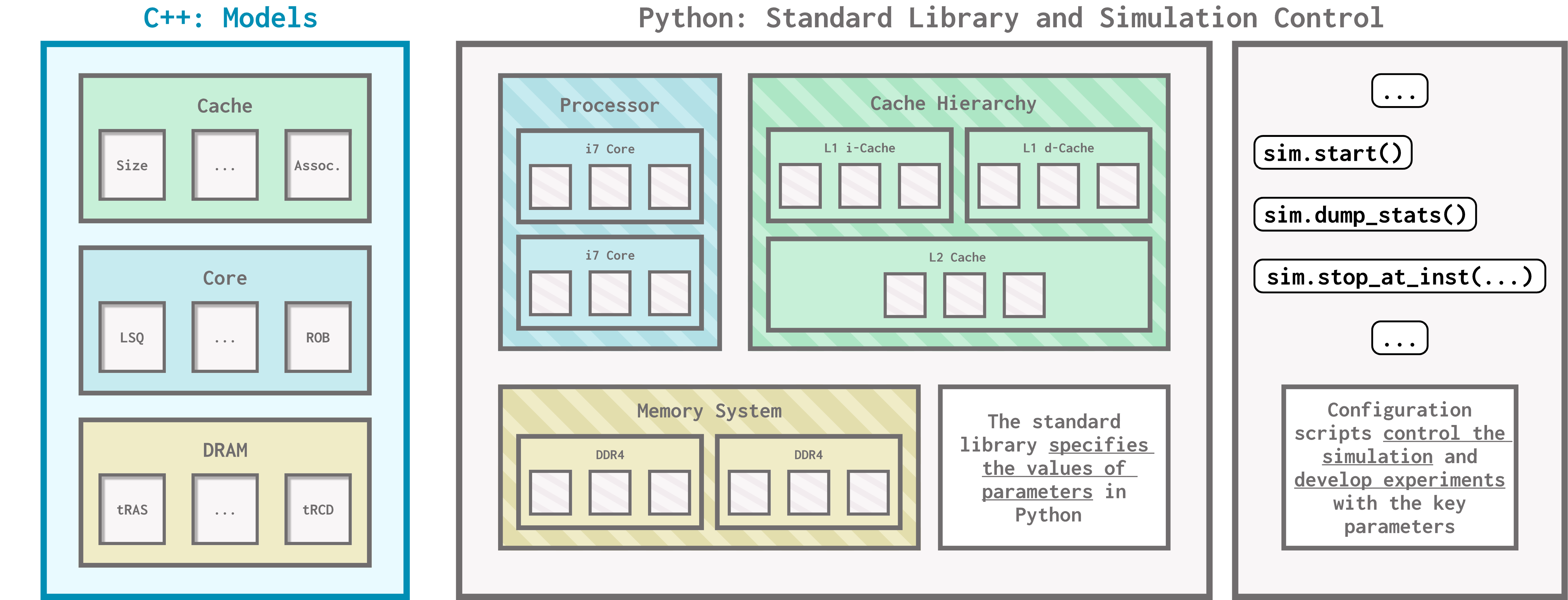
Programmers write Python configuration scripts that define the components of the simulation, then provide them as arguments to the gem5 binary, which runs the simulation.
This means that gem5 is effectively a Python interpreter.
Who is gem5 for?
Anyone, including non-architects, can download and use gem5. gem5 aims to meet the needs of academic research, industry research, and classroom use. The community would love to have you! Take a look at the gem5 repository for the code of conduct (we’ll also visit the repository in the next section!).